

Think about cricket for a second. Not the waiting-around bits—the moment right before impact. Bowler’s arm whips over, ball’s already halfway there, and you’ve got maybe half a breath to read it and commit. InOut Games clearly spent time watching this sport because their newest crash title ditches the whole slot apparatus and builds around that exact tension: your timing versus odds that keep climbing.
November 2025 brought Cricket Road into InOut’s crash portfolio. Sure, looks like another Chicken Road spin-off at first glance, but dismiss it that way and you’re missing the actual hook. Cricket theming here isn’t just aesthetic polish. It’s built into the tempo itself. Every ball arrives with death-over urgency. One botched connection and your run flatlines immediately.
Setup takes maybe ten seconds to grasp. Bet size (₹1 up to ₹16,000), difficulty pick (Easy through Hardcore), smack Go. Ball machine starts launching. Connect clean, tick up one tile, multiplier edges higher. Cash whenever you want. Miss and it’s over.
So what stops this being mindless spam-clicking? Pressure scales geometrically. First handful of tiles? Piece of cake. Around step 15 your hand starts second-guessing itself. Step 20 and you’re having full internal debates. That’s where the game actually exists—not in fancy animations or feature mechanics, but in that psychological gap between “one more can’t hurt” and “probably should stop here.”
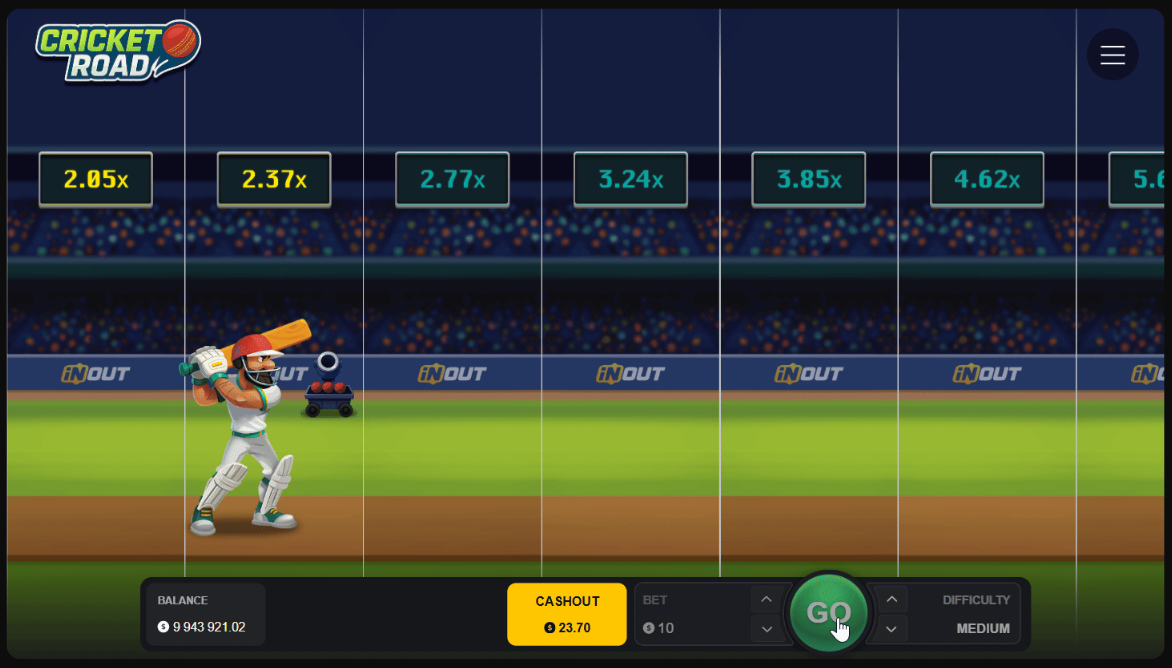
Crash games usually bury their probability models under visual effects. Cricket Road lays it all out visibly. Four difficulty settings fundamentally reshape tile counts, multiplier trajectories, acceleration rates.
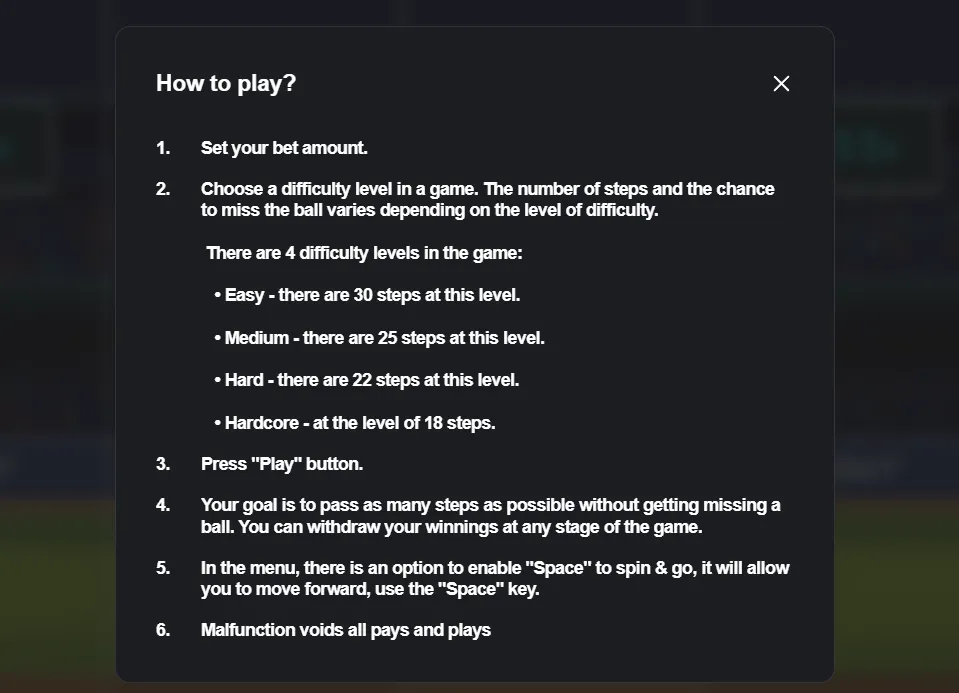
Easy spreads 30 tiles in front of you. Growth stays smooth and predictable. Gives rookies actual room to nail timing mechanics without getting punished instantly. Feels almost meditative—like batting through the first ten overs when nobody’s rushing you. Medium contracts to 25 tiles. Pace lifts, not dramatically but you notice. Error window tightens but stays workable if you’ve put time into Easy.
Hard dumps you into 22 tiles with probability curves that spike noticeably. Ball velocity jumps. Every successful connection feels legitimately earned. Multipliers shoot into four-figure range fast.
| Mode | Tiles | Starting Multiplier | Volatility | Best Suited For |
|---|---|---|---|---|
| Easy | 30 | 1.05x | Low | Testing strategies, building confidence |
| Medium | 25 | 1.10x | Medium | Balanced risk, steady gains |
| Hard | 22 | 1.22x | High | Experienced timing, bigger swings |
| Hardcore | 18 | 1.63x | Extreme | Maximum risk tolerance only |
Hardcore strips it down to 18 tiles and maxes tension completely. Single slip ends it. But nail the landing? Ceiling rockets to x3,608,855.25. Yeah, that’s the actual number—not inflated marketing nonsense. Perfect execution across all 18 and payouts go completely bonkers. Reality check though: probability craters hard past tile 12. Most attempts die well before tile 10.

Same fundamental loop operates across every difficulty—time hit, advance, decide continuation—but the way difficulty warps decision-making changes everything. Easy gives thinking time. Hardcore demands you operate on pure muscle memory and reflex.
Cricket Road sits at 95.5% RTP. Comfortably above most crash titles, sits below InOut’s own Chicken Road (98%). Textbook interpretation says you get back ₹95.50 per ₹100 staked when measured across thousands of rounds. Real sessions? They wander miles off that theoretical average.
RTP tracks performance over genuinely massive sample sizes—millions of rounds. Won’t materialize in your 20-round session. You might bank consistent wins for sixty solid minutes, then watch five consecutive losses nuke your entire gain stack. Not the game rigging outcomes—just volatility being volatility.
Here’s where it gets interesting: volatility scales directly with difficulty selection. Easy and Medium deliver relatively balanced outcomes—smaller wins appear regularly, bankroll bleeds slowly when luck sours. Hard and Hardcore completely amplify swings. Lose more frequently, but when wins land they land considerably harder. Single successful Hardcore run can mathematically erase ten failed attempts.
Why this matters in practical terms:
Difficulty selection here isn’t cosmetic tweaking or interface preference. Tile count determines your maximum possible run length. Fewer tiles mean each individual step carries exponentially more weight. More tiles distribute risk across longer sequences. Tile count only covers half the equation though. Each difficulty tier adjusts underlying probability curves—the invisible computational layer deciding whether your next hit connects or whiffs completely.
Ball velocity shifts with difficulty progression. Easy gives genuine reaction time. Medium noticeably faster. Hard demands sustained focus. Hardcore feels like facing genuine express pace bowling with absolutely zero warmup period. Timing window contracts with each tier jump upward.
Then multipliers shift in ways that completely reshape risk calculations.
| Difficulty | Multiplier at Step 5 | Multiplier at Step 10 | Multiplier at Step 15 | Max Potential |
|---|---|---|---|---|
| Easy | ~1.28x | ~1.65x | ~2.10x | ~100x |
| Medium | ~1.55x | ~2.40x | ~4.20x | ~500x |
| Hard | ~2.10x | ~4.85x | ~12.50x | ~2,000x |
| Hardcore | ~3.20x | ~15.80x | ~185.00x | x3,608,855.25 |
Early returns look decent enough. By step 10 you’re eyeing numbers that could genuinely triple your current stack. That’s precisely when greed starts whispering suggestions. Smart money doesn’t listen.
Most players treat demo as quick five-minute tutorial, then jump straight into real money play. Completely backwards approach. Demo mirrors the full game identically—same tile layouts, same velocity, same multiplier curves. Only meaningful difference is consequence.
Demo reveals your personal behavioral patterns. Do you bail too early from fear? Push past sensible exits because greed takes over? Does Hardcore’s tempo completely overwhelm your timing capacity? Won’t actually know without logging 50+ demo rounds across all difficulty tiers.
Testing strategies costs literally nothing in demo mode. Want to see how a rigid 2x cash-out rule performs measured over 20 rounds? Go for it. Curious whether Hardcore’s ceiling potential justifies the brutal risk profile? Find out without touching actual bankroll. Demo isn’t training wheels for babies—it’s a proper testing lab.
Where players consistently stumble: five quick demo rounds, confidence spikes, switch to real money, lose three straight immediately. Muscle memory needs serious repetition. Timing calibration takes work. Demo gives unlimited attempts to build both elements before real stakes enter the picture.
No bonus rounds exist here. No free spins. No scatter symbols or wild multipliers. No progressive jackpot accumulating value across sessions. If those features matter to your casino experience, wrong game entirely.
Cricket Road focuses purely on incremental step-by-step progression. Each successful hit adds one step. Each step lifts multiplier value. Cash out to lock current winnings. That’s the complete mechanical loop—nothing hidden, nothing extra.
InOut built this experience around continuous decision-making, not random chance triggers or waiting for bonus symbols to align. Autoplay function exists for grinding specific strategies methodically. Set your target steps, round count, difficulty preference. Game executes everything automatically. But autoplay completely guts the core appeal—that moment-by-moment tension of choosing continuation versus stopping.
Some players actively prefer this stripped structure. Others genuinely miss the dopamine spike from traditional bonus features. Cricket Road serves the first group deliberately and ignores the second without apology.
Every outcome gets determined before your round actually begins. Game generates a random seed, runs it through cryptographic hashing, displays it publicly. After round completes, you can personally verify the seed matches the actual result:
Most players never bother checking. Option matters regardless. Means InOut can’t adjust outcomes mid-game under any circumstances. Licensed casinos hosting Cricket Road can’t tilt results toward house edge beyond the built-in RTP percentage. Transparency becomes mathematically verifiable, not just marketing language.
Security extends well beyond fairness mechanics. Licensed platforms encrypt all payment data, undergo regular third-party audits, maintain strict separation between player funds and operational capital. Cricket Road runs exclusively on these platforms—zero sketchy offshore operators or dodgy APK downloads from questionable sources.
For Indian players specifically, this matters in concrete practical terms. UPI, Paytm, GPay, PhonePe deposits hit accounts instantly. Withdrawals typically clear within minutes to maybe few hours maximum. Infrastructure feels immediately familiar because platforms use identical payment gateways as mainstream consumer apps everyone already trusts.
| Payment Method | Typical Processing Time | Minimum Withdrawal | Maximum Daily Limit |
|---|---|---|---|
| UPI | 5-30 minutes | ₹100 | ₹100,000 |
| Paytm | 10-60 minutes | ₹100 | ₹100,000 |
| GPay | 5-30 minutes | ₹100 | ₹100,000 |
| PhonePe | 10-60 minutes | ₹100 | ₹100,000 |
| Bank Transfer | 1-3 hours | ₹500 | ₹500,000 |
| Cryptocurrency | 10-120 minutes | ₹200 | Varies by casino |
Demo and real money Cricket Road are mechanically identical down to the decimal point. Psychology? Completely different animal. Demo rounds feel purely exploratory—no emotional weight. Real money triggers genuine hesitation every single time.
Demo mode lets you casually push to step 25 just to observe what happens. Real stakes? Suddenly step 15 feels legitimately dicey. Multiplier numbers carry completely different psychological weight. That 8.5x looks pretty generous when nothing’s actually at risk. When it represents genuine profit sitting in your balance, 8.5x becomes “good enough” considerably faster than you’d expect.
Timing accuracy frequently drops once money enters the equation. Hands physically tense up. Clicks land fractionally early or fractionally late. Game mechanics haven’t changed one bit—you have.
InOut built Cricket Road using HTML5 technology. Runs directly in mobile browsers, zero downloads required. No app installation needed. Zero device storage consumed. Just hit the casino site, locate game, start playing immediately.
Mobile interface mirrors desktop layouts but optimizes everything for touch controls specifically. Your thumb hits that strike button cleanly every time. Screen size doesn’t cramp visibility annoyingly. Multiplier displays stay perfectly readable. Bet adjustments respond instantly to touch input.
Where mobile completely falls apart: precision timing at genuinely high speeds. Hardcore mode on a small phone screen while commuting on a bumpy bus? Absolutely brutal experience. Ball comes ridiculously fast, thumb needs pixel-perfect accuracy, one bump from another passenger ruins everything instantly. Easy and Medium handle mobile conditions considerably better—slower pace naturally forgives slightly imperfect taps.
Some casinos offer dedicated native apps that include Cricket Road in their game libraries. These load marginally faster, maintain game state slightly better, offer fractionally smoother animations. But the difference isn’t dramatic enough to justify downloading a whole app unless you’re genuinely playing daily.
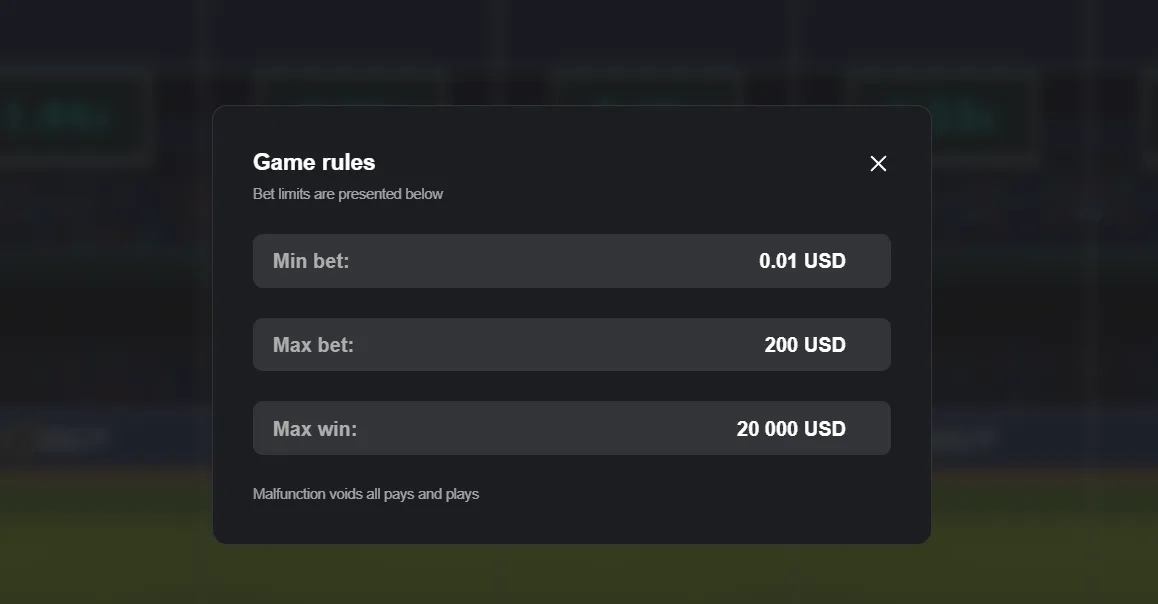
Minimum bet starts at one rupee—₹1. Maximum hits ₹16,000 per round. That spread accommodates both ultra-cautious testing and genuinely aggressive high-roller hunting equally well.
Smart bankroll management in practical terms looks like:
Players constantly make the exact opposite mistake—betting big on Hardcore mode while chasing that x3.6mn multiplier ceiling. Then three quick consecutive losses instantly wipe 30% of total balance. Correct approach flips this: bet small on high volatility modes, marginally larger on low volatility modes.
Consistent winning players follow established patterns, not gut instincts or emotional impulses. Fixed target exits completely remove emotional decision-making from the equation. “Cash at 2x every single round” sounds painfully boring on paper but steadily accumulates profit over time. Chasing 20x multipliers occasionally lands huge, but frequent losses mathematically erase those gains.
Alternative strategic approach: difficulty switching based purely on recent results. Start in Easy until three profitable rounds land consecutively. Move to Medium for improved multiplier potential. Bad session hits? Drop straight back to Easy. This rhythm adjusts risk exposure dynamically without emotional escalation entering the picture.
Performance-based exits operate on completely different logic. Continue playing only while timing genuinely feels sharp and controlled. The exact moment you miss a beat or accidentally double-tap, cash out immediately regardless of current multiplier.
| Strategy Type | Risk Level | Time Investment | Skill Required | Bankroll Suited For |
|---|---|---|---|---|
| Fixed 2x Exit | Low | Minimal | Beginner | ₹1,600-8,000 |
| Difficulty Ladder | Medium | Moderate | Intermediate | ₹8,000-40,000 |
| Performance-Based | Medium-High | High | Advanced | ₹16,000+ |
| Hardcore Sniper | Extreme | Very High | Expert | ₹40,000+ |
Trust physical feedback signals over multiplier temptation every single time. Your body frequently recognizes deteriorating focus before conscious mind catches up.
Loss recovery demands discipline most players simply don’t possess. After three losing rounds consecutively, that urge to bet significantly bigger and immediately recoup losses hits extremely hard. That specific impulse destroys more bankrolls than bad timing ever could. Correct move: maintain exact same stake size or actively reduce it. Chasing losses mechanically converts bad luck into genuine catastrophe.
Most crash games basically dress up identical core mechanics with superficially different themes. Planes, rockets, cartoon characters—same fundamental formula hiding underneath cosmetic differences. Cricket Road initially looks similar but fundamentally changes the psychological equation in meaningful ways.
Cricket framing resonates specifically in geographic regions where the sport completely dominates cultural attention. Indian players instinctively recognize the embedded rhythm: pause between deliveries, split-second commitment to shot selection, immediate consequence of mistiming. That deep familiarity makes mechanics feel naturally intuitive rather than arbitrarily imposed.
Difficulty granularity also legitimately separates Cricket Road from direct competitors. Four genuinely distinct modes with meaningfully different statistical characteristics let players calibrate risk exposure with actual precision. Many competing crash games offer exactly two settings—safe or extreme—with absolutely nothing in between. Cricket Road’s full spectrum serves considerably broader player preferences.
The timing mechanic itself fundamentally shifts responsibility dynamics. In passive crash games, you watch a line climb passively and decide when to exit. Cricket Road demands active participation every single step. Each hit requires direct input from you. Missing isn’t random bad luck—it’s a mistimed click that’s entirely on you. That agency matters significantly to players who prefer skill influence over pure random chance.
Greed kills more bankrolls than genuinely bad timing ever could. Watching multiplier climb steadily past your predetermined target while thinking “just one more step won’t hurt” almost universally ends with losing absolutely everything. Multiplier doesn’t care about your carefully laid plans. Just keeps climbing relentlessly until the hidden trap finally hits.
Ignoring difficulty impact represents another fatal trap players walk into constantly. Players jump straight to Hardcore mode assuming higher multiplier ceiling automatically means improved odds of profit. Then lose ten consecutive rounds and blame the game for being “rigged.” Hardcore’s ceiling is objectively higher, sure—but its floor is proportionally lower. Basic probability doesn’t favor impatience.
Misunderstanding RTP mechanics creates completely false expectations that lead to bad decisions. 95.5% return percentage doesn’t mean winning 95.5% of the time. Means the game pays back that specific percentage when measured over genuinely massive sample sizes—millions of rounds.
Your personal 20-round session might show 70% return or 110% return completely randomly. Short-term results wander wildly—that’s literally how statistical variance functions normally. Playing while emotionally tilted guarantees losses:
Licensed casinos across India, UK, plus other major regulated markets host Cricket Road through official InOut partnerships. Look exclusively for platforms displaying genuinely valid regulatory licenses (Curacao, Malta, UK Gambling Commission specifically). Actively avoid unlicensed sites promising unrealistically bigger bonuses—they’re never worth the regulatory risk.
Payment method support directly signals platform legitimacy. Real casinos offer UPI, all major e-wallets, standard card deposits, cryptocurrency options. Withdrawals process quickly—usually within hours, definitely not days. If any site takes three full days just approving withdrawal requests, that’s an immediate red flag worth noting.
Customer support responsiveness matters significantly for platform selection. Test it actively before depositing anything. Ask specific questions about Cricket Road’s RTP percentage or withdrawal limit policies. Quality casinos answer within literal minutes, 24/7 availability. Slow or deliberately evasive support strongly suggests operational problems beneath the surface.
Bonus offers targeting crash games specifically are relatively rare but definitely exist. Welcome packages occasionally include free play credits explicitly usable on Cricket Road. These effectively extend your testing period before committing actual personal funds. Read bonus terms extremely carefully though—wagering requirements attached to bonuses can be genuinely steep.
Really depends what you personally want from casino gaming experiences. Prefer complex narratives, elaborate bonus feature mechanics, or purely passive entertainment? This absolutely isn’t it. Cricket Road is mechanical, deliberately repetitive, outcome-focused by explicit design.
But if timing-based challenges genuinely appeal—if you actively enjoy feeling directly responsible for results rather than passively watching random spins resolve—Cricket Road delivers that experience cleanly and without unnecessary clutter.
Skill ceiling sits low enough for complete beginners to grasp core mechanics quickly but remains high enough that deliberate practice noticeably improves performance over time. RTP sits solidly above industry average figures without quite reaching Chicken Road’s impressive 98%. Volatility adjusts cleanly with difficulty selection, giving players direct control over risk exposure levels. Stripped design means learning curves stay genuinely shallow while decision-making pressure remains consistently sharp.
For Indian cricket fans specifically, thematic resonance adds legitimate subtle value beyond pure mechanics. Game doesn’t just superficially borrow cricket imagery—it actively mirrors the sport’s embedded tension structure. That emotional translation makes each individual round feel considerably less like pure gambling and more like facing a critical delivery requiring proper technical handling.
Cricket Road won’t replace traditional slot machines in market dominance. Serves a fundamentally different audience: players actively wanting direct input, completely transparent mathematical models, and results tied directly to personal timing execution rather than waiting passively for scatter symbols to randomly align. That specific audience keeps growing steadily, and InOut’s latest release gives them precisely what they’re actively seeking—nothing more, nothing less.
Vous ne pouvez pas copier le contenu de cette page